
Every town has its stories.
They are etched into bronze plaques mounted in public squares. They fill the pages of local history books sitting quietly in libraries. They are retold during festivals, parades, and school lessons, passed down from generation to generation.
These stories often speak of courage, perseverance, and the determination of those who built communities from nothing.
But sometimes, history is more complex than it appears on the surface.
In one quiet American town, a routine construction project recently prompted a renewed examination of its origins — not through rumor or speculation, but through an unexpected discovery buried deep underground.
What construction workers uncovered that morning did not just pause their workday. It sparked conversations that would eventually reshape how many residents understood their town’s past.
This is the story of a discovery that raised questions, encouraged reflection, and reminded a community that history is often layered — both figuratively and literally.
A Typical Construction Project — Until It Wasn’t
The project itself was unremarkable.
A development company had purchased a downtown lot, intending to replace an aging estate that had stood there since the early 20th century. Like many older properties, the structure had deteriorated beyond practical repair. The plan was simple: demolish the existing foundation and prepare the site for modern construction.
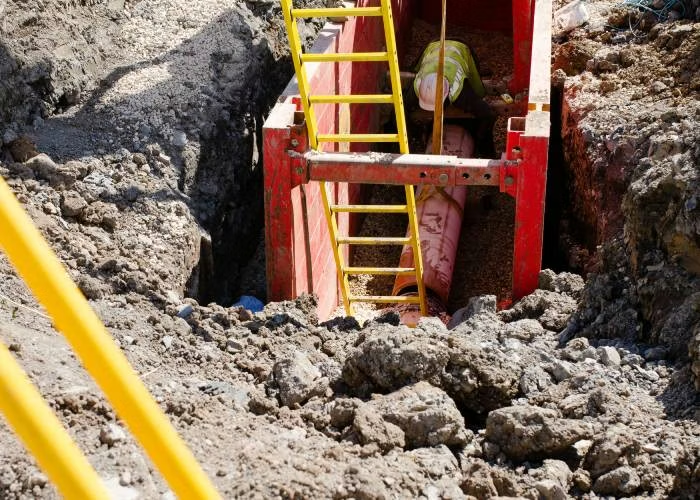
On an ordinary weekday morning, construction crews began excavation.
Heavy machinery moved soil that had remained undisturbed for decades. Workers followed routine procedures — clearing debris, breaking through old concrete, and removing brick layers from the original foundation.
Nothing suggested that the day would be any different from countless other construction projects carried out across the country.
Until the excavator hit something unexpected.
An Unusual Sound Beneath the Surface
At approximately mid-morning, the excavator’s steel bucket struck an object that produced a distinct metallic sound.
It was not the dull resistance of rock. Nor was it the brittle cracking of old concrete.
The operator stopped immediately.
Workers gathered near the excavation pit, curious about what lay beneath. Slowly, they began clearing soil by hand to avoid damaging whatever had been uncovered.
Buried nearly 15 feet below the surface was a rectangular metal object.
It was heavily corroded with rust.
And it appeared to be secured with chains.
Careful Handling and Professional Assessment
Construction supervisors followed proper protocol. Work was paused while local authorities and site inspectors were notified.
Situations like these require caution. Buried objects can range from harmless historical artifacts to potentially dangerous materials. Officials arrived to assess the object and ensure it could be safely handled.
Once cleared, the object was carefully removed from the ground.
It was a metal chest.
The chest showed clear signs of age. Its surface bore marks of prolonged exposure to moisture and soil. The chain securing it was similarly weathered, and a thick padlock sealed its contents.
Given the chest’s condition and the circumstances of its burial, officials recommended that it be opened carefully, in a controlled environment.
Opening the Chest
With no key available, bolt cutters were used to remove the lock.
The lid creaked as it was opened for the first time in many decades.
Inside, workers did not find valuables or jewelry.
Instead, they found documents.
Several leather-bound ledgers, wrapped in protective cloth, had been preserved remarkably well despite their long burial.
The documents were immediately transferred to local historical experts for examination.
At that moment, no one knew exactly what they would reveal.
The Role of Local Historians
Small towns often rely on dedicated historians and archivists to preserve their heritage.
These individuals understand the importance of careful analysis. They approached the ledgers methodically, first verifying their authenticity and approximate age.
The paper, ink, and binding materials suggested the ledgers dated back to the late 19th century.
As historians reviewed the entries, they began recognizing familiar names.
These names appeared throughout the town’s recorded history — individuals credited with founding businesses, supporting infrastructure development, and shaping the community’s early growth.
Their contributions had long been considered part of the town’s legacy.
The ledgers provided additional context to that period.
Understanding Historical Context
It is important to recognize that historical records often reflect complex realities.
Economic development in the 1800s was shaped by many factors: industrial expansion, railroad construction, migration patterns, and evolving property laws.
Transactions involving land, investment, and infrastructure were common and sometimes complicated.
The ledgers appeared to document financial activities connected to land ownership and development during that time.
Historians emphasized that interpreting such records requires careful, responsible analysis. Historical documents must be evaluated alongside other archival materials to understand the full picture.
Still, the discovery added valuable insight into a pivotal era of the town’s growth.
Why Documents Were Sometimes Preserved in Unusual Ways
Before modern archival systems, people preserved important records in various ways.
Some stored documents in safes or lockboxes. Others concealed materials for privacy or protection. Burial, while less common, was not unheard of — particularly when individuals wanted to ensure long-term preservation or secrecy.
Environmental conditions underground can sometimes help preserve paper, especially when wrapped in protective materials.
In this case, the cloth wrapping likely shielded the ledgers from moisture damage.
This preservation allowed historians to examine the records more than a century later.
Community Response and Reflection
News of the discovery spread quickly through the town.
Residents were naturally curious.
For many, the town’s history was a source of pride. Schools taught local heritage, and landmarks honored early community leaders.
The discovery did not erase that history. Instead, it encouraged deeper discussion about how communities grow and evolve.
Public meetings were held. Historical societies shared updates. Local museums expressed interest in preserving the documents for educational purposes.
Residents asked thoughtful questions:
What can we learn from these records?
How should historical discoveries be presented responsibly?
What do they teach us about the past?
These conversations reflected a community engaging constructively with its heritage.
The Importance of Historical Preservation
Discoveries like this highlight the importance of preserving historical records.
Without careful documentation, many aspects of history would be lost.
Historians rely on primary sources — letters, ledgers, photographs, and official records — to build accurate narratives.
New discoveries can add nuance and depth to existing knowledge.
They help historians refine timelines, understand economic conditions, and examine how communities formed.
Importantly, responsible historical interpretation avoids oversimplification.
History rarely fits into simple categories of right and wrong. It is shaped by human decisions, economic pressures, and social contexts.
Museums and Public Access
Following proper preservation procedures, the ledgers were eventually transferred to local archival authorities.
Experts used conservation techniques to stabilize the materials and prevent deterioration.
There were discussions about displaying the ledgers in a museum setting.
Such displays can serve educational purposes, helping residents and visitors understand the town’s development more fully.
Museums often present discoveries alongside explanatory materials that provide context and balanced interpretation.
This ensures the public receives accurate, responsible information.
How Construction Projects Sometimes Reveal History
Construction and excavation projects have long played a role in uncovering historical artifacts.
Across the world, workers have discovered coins, tools, letters, and even entire structures hidden beneath modern buildings.
These discoveries remind us that cities and towns are built layer upon layer.
What exists today often rests atop earlier generations’ foundations.
In some cases, discoveries lead to archaeological studies. In others, they contribute to local museum collections.
Each find adds another piece to the historical puzzle.
The Role of Professional Analysis
It is essential to emphasize that historical discoveries require careful verification.
Experts use multiple methods to confirm authenticity, including:
- Material analysis
- Ink composition testing
- Paper aging assessment
- Handwriting comparison
- Cross-referencing archival records
This ensures conclusions are based on evidence rather than speculation.
Responsible analysis protects historical integrity.
Why Stories Like This Capture Attention
People are naturally drawn to stories about discovery.
They remind us that history is not static.
It is something we continue to learn about and understand more deeply over time.
Unexpected finds encourage curiosity.
They prompt questions.
They inspire research.
Most importantly, they connect modern communities with their past.
A Reminder Beneath Our Feet
The construction site eventually resumed work.
The excavation pit was cleared, and the development project continued.
But the discovery left a lasting impression.
It demonstrated how easily the past can remain hidden — not intentionally forgotten, but simply buried beneath the passage of time.
The ledgers became part of the town’s broader historical record.
Not as a source of controversy, but as a valuable artifact that helps historians and residents better understand their community’s evolution.
History Is Always Being Written
History is not a fixed narrative carved in stone.
It is an ongoing process of discovery, interpretation, and learning.
Each new piece of evidence helps refine our understanding.
Each discovery encourages reflection.
And each generation adds its own perspective.
The locked chest beneath that old foundation did not change the town overnight.
But it reminded everyone of something important:
There is always more to learn.
The Value of Looking Deeper
Whether in small towns or large cities, countless stories remain hidden beneath the surface.
Some may never be found.
Others may emerge unexpectedly.
What matters most is how communities respond — with curiosity, responsibility, and respect for historical truth.
Because understanding the past helps us better understand the present.
And sometimes, the most ordinary days can lead to discoveries that remind us just how much history still surrounds us.