
It started as an ordinary afternoon.
Steven wasn’t searching for treasure. He wasn’t hoping to uncover anything unusual. Like many homeowners, he was simply working in his backyard, focused on improving the garden he and his wife had spent years maintaining.
The soil was firm but manageable. He dug carefully, clearing old roots and leveling uneven patches. It was the kind of quiet, routine work that rarely leads to surprises.
But that day, something unexpected interrupted the rhythm of his shovel.
At first, Steven thought it was just a rock.
But as he bent down to examine what he had struck, he realized it was something else entirely.
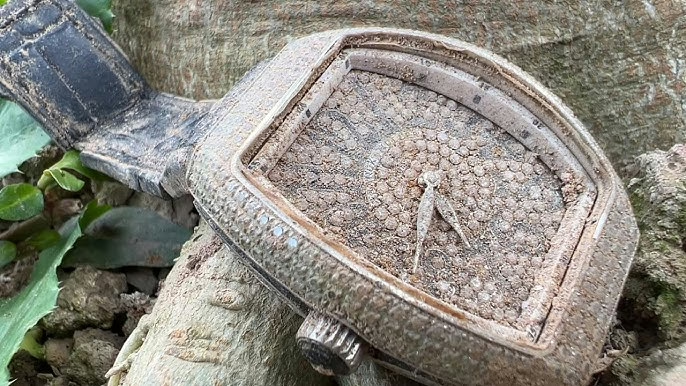
Partially buried beneath layers of hardened dirt was an object unlike anything he had seen in his garden before.
It was small. Heavy. And completely covered in mud.
It was a watch.
A Discovery That Raised More Questions Than Answers
Steven picked up the object carefully.
The watch was barely recognizable. Years — possibly decades — of exposure to moisture and soil had left it encased in a hardened shell of dirt. Its surface was hidden beneath layers of dried mud, and its glass appeared cracked.
There was no visible brand.
No markings.
No obvious clues about where it had come from.
Steven was certain of one thing — it wasn’t his.
He and his wife had only moved into the house a few years earlier. Neither of them had ever owned or lost a watch like this.
Which meant the watch had likely been there long before they arrived.
But how long?
And more importantly — why was it buried in the first place?
The First Instinct — And a Critical Decision
Like many people would, Steven’s first instinct was simple: clean it.
He considered rinsing the watch under the faucet, hoping water would wash away the dirt and reveal identifying details beneath.
But when he mentioned the idea to his wife, she immediately objected.
She pointed out something important.
If the watch was old — or potentially valuable — improper cleaning could damage it permanently.
Mud and debris can sometimes protect delicate surfaces. Washing it improperly could remove finishes, scratch components, or destroy subtle identifying marks.
Instead, she suggested something else.
Take it to a professional.
Seeking Expert Help
Steven contacted a local jewelry professional for advice.
After explaining the condition of the watch, he was referred to a specialist who handled delicate cleaning and restoration of old timepieces.
The specialist warned Steven of something he hadn’t fully considered.
Careful restoration would take time.
And it wouldn’t be inexpensive.
Cleaning and restoring a watch in unknown condition requires precision. Each component must be handled carefully to avoid causing further damage.
Steven faced a decision.
Was it worth the cost — and the risk — to restore something whose value was completely unknown?
After discussing it with his wife, they agreed.
The uncertainty was frustrating.
But the curiosity was stronger.
Steven scheduled the restoration.
The Restoration Process
When Steven arrived at the restoration shop, the specialist examined the watch closely.
Even through the dirt, he could tell it had significant age.
Carefully, he began removing the hardened layers of mud using specialized tools and techniques designed to protect fragile surfaces.
The process was slow.
Bit by bit, the watch began to reveal itself.
The metal casing emerged.
The cracked glass became visible.
The underlying structure appeared surprisingly intact.
Despite its condition, the watch had survived.
But as the cleaning continued, one surprising detail remained consistent.
There was still no visible brand.
An Unusual Absence
Most watches carry clear identification.
Brand names, serial numbers, logos, or engravings usually provide clues about origin and value.
But this watch showed none of those things.
It didn’t match any common production model.
The specialist admitted something unusual.
He didn’t recognize it.
Despite years of experience, he had never seen a watch quite like this one.
This left Steven with more uncertainty than answers.
He had invested in restoring the watch.
But without identifiable origin, its value remained unclear.
There was only one more step he could take.
He needed a second opinion.
The Jeweler’s Reaction
Steven brought the restored watch to the jeweler he had initially contacted.
The shop was quiet.
Closing time was approaching.
The jeweler took the watch and began examining it carefully.
For a moment, he said nothing.
Steven watched anxiously.
Seconds passed.
Then nearly a full minute.
The silence felt longer.
Finally, the jeweler spoke.
And what he said surprised Steven completely.
He recognized the watch.
But not because of a brand name.
Because of its history.
A Watch Without a Brand — But With a Story
According to the jeweler, not all watches are created for commercial sale.
Some are made privately.
Custom pieces.
Unique designs.
Commissioned for individuals rather than mass production.
These watches often lack traditional branding.
Instead, their value comes from craftsmanship, rarity, and provenance — the documented history of ownership.
The jeweler explained that watches like this were sometimes produced in limited numbers or even as one-of-a-kind items.
Their importance lies not only in materials, but in the stories attached to them.
The jeweler suggested that further research would be necessary to determine the watch’s full background.
But one thing was already clear.
It wasn’t ordinary.
How Watches Become Valuable Over Time
Many factors influence the value of a watch:
- Craftsmanship and materials
- Historical significance
- Rarity
- Condition
- Provenance (ownership history)
- Market demand
Even watches without famous brand names can carry significance if they have unique origins.
Collectors often value pieces that represent specific time periods, personal commissions, or unusual designs.
In some cases, the story behind the watch becomes just as important as the watch itself.
The Role of Professional Authentication
To understand the watch’s full significance, experts would need to examine it further.
Authentication often involves:
- Mechanical analysis
- Metal composition testing
- Design comparison
- Historical research
- Provenance verification
These steps help establish origin, age, and authenticity.
Responsible evaluation ensures accurate historical and financial assessment.
Without proper verification, assumptions about value remain speculative.
Why Objects End Up Buried
It may seem unusual to find a watch buried in a garden.
But throughout history, valuable or meaningful items have been hidden for many reasons.
People sometimes buried possessions to protect them during uncertain times.
Others may have lost items accidentally.
Properties change ownership, landscapes shift, and objects can remain hidden for decades.
Over time, soil, moisture, and natural processes conceal them completely.
Until one day, someone digging in the right place uncovers them again.
The Emotional Impact of Unexpected Discoveries
For Steven, the discovery wasn’t just about potential value.
It was about mystery.
Questions without immediate answers.
Where did the watch come from?
Who owned it?
Why was it buried?
Discoveries like this connect people to the past in unexpected ways.
They remind us that every place carries layers of history.
Sometimes hidden just beneath the surface.
The Next Steps
The jeweler recommended further evaluation.
Specialists in antique timepieces could examine the watch in greater detail.
Historical researchers might uncover clues about its origin.
Collectors might recognize its design.
Each step could bring new insight.
But regardless of financial value, the watch had already become something meaningful.
It was a tangible link to an unknown story.
Why Stories Like This Fascinate People
Objects discovered by chance often capture public imagination.
They remind us that history is not confined to museums.
It exists all around us.
In homes.
In gardens.
In places we see every day.
Sometimes, the most ordinary settings hold extraordinary stories.
Not because of what the objects are made of.
But because of where they’ve been.
A Reminder Beneath the Surface
Steven returned home with the watch.
He still didn’t know everything about it.
But he knew enough to understand one thing.
The watch was more than just an object.
It was a mystery waiting to be understood.
Its journey had brought it from an unknown past into his hands.
And its full story was still waiting to be discovered.
History Doesn’t Always Announce Itself
Most people never expect to uncover something unusual in their own backyard.
Yet discoveries like this happen more often than many realize.
Old coins.
Documents.
Tools.
Personal belongings.
Each object represents a moment in time.
Each holds a story.
And sometimes, those stories remain hidden for generations.
Until someone like Steven finds them again.
The Value of Curiosity
Steven’s decision to investigate the watch carefully made all the difference.
Instead of discarding it, he sought professional guidance.
Instead of rushing to conclusions, he explored its background responsibly.
Curiosity led him to answers.
And possibly to even more questions.
Because history doesn’t always reveal itself all at once.
Sometimes, it unfolds slowly.
One discovery at a time.
What Would You Do?
If you found something unexpected buried beneath your own property…
Would you ignore it?
Would you investigate?
Would you wonder about the story behind it?
Steven didn’t expect to find anything that day.
But his discovery reminded him — and everyone who hears his story — of something important.
Sometimes, the past waits patiently.
Hidden beneath layers of time.
Until someone uncovers it.